
How Mobile Phlebotomists Get Samples to the Lab Safely
Having blood taken at home is convenient. Many people still wonder what happens once the mobile phlebotomist packs up and leaves. Does a home blood test sample get the same care as one taken in a hospital?
In short, trained mobile phlebotomists label each tube in front of you and seal it in leak-proof triple packaging. The sample is kept at the temperature the laboratory asks for and reaches the lab within the time the test allows. Each step protects the quality of your sample, so your result reflects your health and not the journey.
Key takeaways
- Every tube should be labelled at your side and matched to your request form before it leaves your home.
- In the UK, patient samples travel in triple packaging marked UN3373, “Biological Substance, Category B”.
- Most routine samples travel at a stable room temperature. Some need cooling or protection from light, as the lab directs.
- Timing matters. NHS laboratories generally ask for samples to arrive on the day they are taken.
- Careful collection and transport help make home blood test results reliable. A result is not a diagnosis, so your doctor will interpret it.
This guide follows your sample from the moment the needle comes out to the moment your results arrive.
How Does Mobile Phlebotomy Work From Your Door to the Lab?
So how does mobile phlebotomy work in practice? A trained blood-taking professional comes to your home or workplace, collects your sample and makes sure it reaches the laboratory in the right condition. The collection itself is usually quick. The care that follows matters just as much.
Most home visits follow six steps:
- Booking. You choose a home or clinic appointment, give your address and pick a date and time.
- The visit. The phlebotomist checks your details and your request form, then takes your blood.
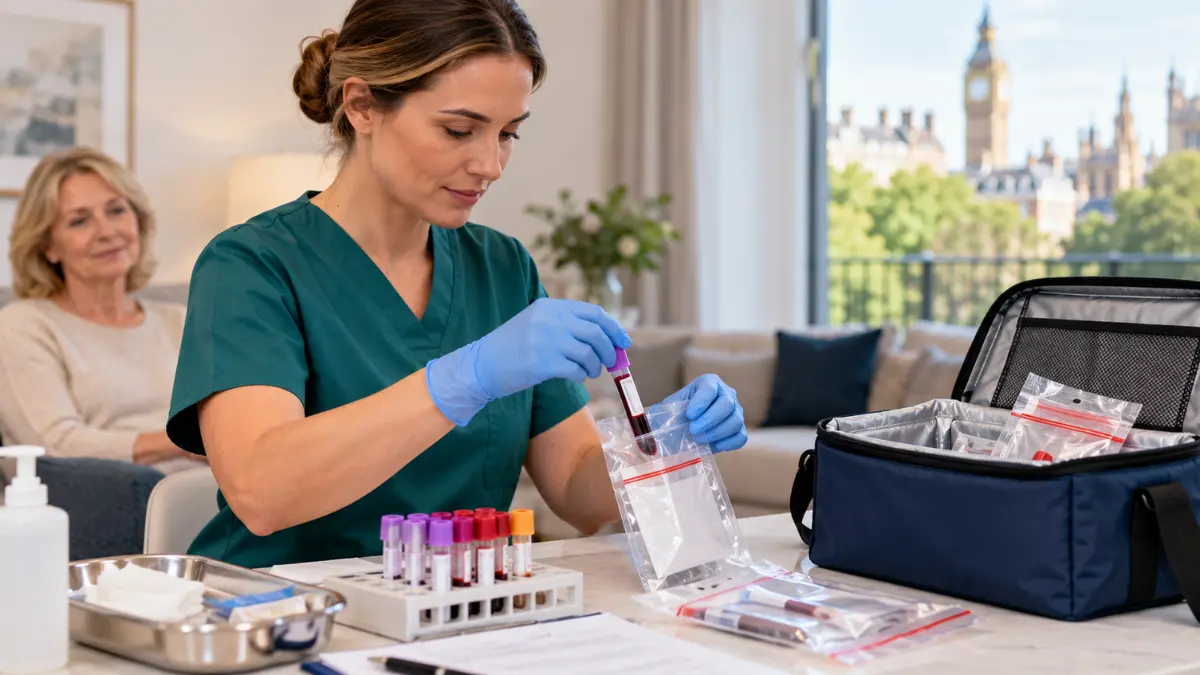
- Labelling. Each tube is labelled at your side before it leaves the room.
- Packaging. The tubes are sealed in leak-proof, triple-layer packaging.
- Transport. The sample travels to the lab at the right temperature and within the right timeframe.
- Testing and results. The lab analyses the sample and the results are sent to you or your doctor.
Booking Your Visit and Preparing Your Request Form
If your GP, consultant or private clinic has asked for blood tests, keep the request form ready. It tells the phlebotomist which tubes to use and tells the laboratory which tests to run. If your doctor has asked you to fast or to change when you take a medicine, follow their instructions. Don’t guess.
What Happens During the Home or Office Visit
The phlebotomist confirms your name and date of birth, prepares the area and draws the sample, usually from a vein in your arm. NHS guidance says a blood test usually takes about 10 minutes. For a fuller picture of the appointment, read our guide on what to expect during a home phlebotomy visit.
The Moment Your Sample Leaves Your Home
Once the plaster is on, the sample’s journey begins. From this point, everything is about protecting what the laboratory will measure.
How Much Blood Do They Take During a Home Blood Test?
Many people ask, before a blood test, how much do they take? It is usually less than you might expect. In most cases, only a few small tubes are needed, and each holds just a few millilitres.
Why the Number of Tubes Depends on Your Tests
There is no single amount for every blood test. It depends on which tests your doctor or clinic has requested. A single check may need one tube, while a wider panel may need several. Your phlebotomist will only take what the tests on your form require.
What the Different Coloured Tube Tops Are For
Each tube top colour signals a different additive inside. Some tubes help the blood clot so the lab can test serum. Others stop clotting so the lab can test whole blood or plasma. The tubes are filled in a set sequence, known as the order of draw, so additives don’t carry over from one tube to the next.
This matters for transport too. Different tubes behave differently over time and at different temperatures, which is why careful handling continues after the draw.
If you tend to feel anxious or light-headed, our tips on managing anxiety during blood collection may help.
Labelling and Identification Before Your Sample Travels
A perfectly collected sample is no use if the laboratory can’t be sure whose it is. That is why labelling happens before the phlebotomist leaves your side.
Matching Every Tube to the Right Patient
Each tube is labelled at the time of collection with your details, usually your full name and date of birth, plus the date and time of collection. NHS community procedures, such as Rotherham NHS Foundation Trust’s sample transport guidance, list name, date of birth, NHS or hospital number and collection date as standard details.
Incomplete or mismatched labels are a common reason laboratories reject samples. Accurate labelling helps you avoid an unnecessary repeat visit.
The Request Form and Chain of Custody
The request form travels with your sample. Together, the labelled tubes and the form create a clear record of who the sample belongs to, when it was taken and which tests are needed. This unbroken record from your arm to the laboratory is known as the chain of custody. Read more in our article on phlebotomy guidelines and best practices.
The Mobile Phlebotomy Equipment That Protects Your Sample
Good mobile phlebotomy equipment is about more than needles and tubes. Much of it is designed to keep your sample stable and secure on the way to the laboratory.
Leak-Proof Specimen Bags and Triple Packaging
Blood samples travel in layers. The tube is the first layer. It goes into a sealed, leak-proof specimen bag with absorbent material, which then goes into a sturdy outer container. If a tube ever cracked, the leak would stay contained.
Keeping Samples at the Right Temperature
Temperature is one of the most important parts of blood sample handling, but not every sample needs the same conditions.
| Sample type | Typical handling | Why it matters |
| Most routine blood samples | Kept at a stable room temperature | Extreme heat or cold can change some results |
| Some specific tests | Cooled, as instructed by the laboratory | Certain substances break down quickly at room temperature |
| A small number of light-sensitive tests | Protected from light | Light can affect substances such as bilirubin |
Samples That Travel at Room Temperature (H4)
Many routine samples are best kept stable at room temperature. NHS community courier procedures, for example, keep samples between 15°C and 25°C, with the highest and lowest temperatures recorded electronically on each run.
Samples That Need Cooling With Ice Packs
Some tests need the sample kept cool, sometimes with ice packs or in a cool box. The receiving laboratory sets this requirement for each test.
Samples That Need Protecting From Light
A few tests are sensitive to light. These samples may be wrapped or kept in a covered container until they reach the lab.
Portable Centrifuge for Samples That Need Separating
Some samples change if they stay unseparated for too long. NHS guidance from Bristol, North Somerset and South Gloucestershire notes that serum left overnight can become unsuitable for tests such as potassium, phosphate, LDH and glucose unless it has been centrifuged.
A centrifuge spins the sample to separate serum or plasma from the blood cells. London Phlebotomy offers a portable centrifuge service for separating serum, plasma and buffy coat on site, which can help when a sample needs processing before it travels.
Sharps Disposal and Infection Control on Home Visits
Used needles go straight into a sealed sharps container, and gloves and swabs are disposed of safely. This protects you, your household and everyone who handles the sample afterwards.
By Car or Mobile Phlebotomy Van, the Same Standards Apply
Whether a sample travels by car or in a mobile phlebotomy van, the vehicle matters less than how the sample is carried inside it.
Keeping Samples Upright, Secure and Away From Heat
NHS community procedures show what good practice looks like:
- Samples travel in the rear of the vehicle, not in the driver’s compartment.
- Sample bags are never placed directly on the vehicle floor.
- If a leak happens, the packaging stays sealed so the spill is contained.
- Samples are kept away from heaters, direct sunlight and freezing conditions.
These points come from Rotherham NHS Foundation Trust’s community transport guidance and BNSSG storage advice.
Why Timing Matters on the Way to the Lab
Blood keeps changing after it leaves the body. Cells continue to use glucose, and some substances slowly leak out of cells. That is why NHS laboratories generally ask for samples to arrive on the day they are taken. Oxford University Hospitals, for example, asks for samples to reach the lab within 24 hours and advises against collections that would sit over a weekend.
In London, this means planning around travel time, traffic and laboratory opening hours. It is also why some appointments work better earlier in the day.
Why Each Laboratory Sets Its Own Handling Rules
There is no single UK rule for every sample. One NHS laboratory may ask for samples to stay at room temperature. Another may ask for refrigeration at 4–8°C if a sample can’t be sent straight away. Some tubes should be centrifuged before storage, while others, such as fluoride tubes, should not.
A careful mobile phlebotomist follows the receiving laboratory’s instructions for each test, not a one-size-fits-all routine. If you’re booking a home blood test with London Phlebotomy, the team can talk you through any preparation your tests need.
Mobile Phlebotomy UK Packaging Rules and UN3373
For mobile phlebotomy, UK rules treat patient samples sent for testing as a biological substance, and they must be packed to a recognised standard. This is where the code UN3373 comes in.
What UN3373 Means on a Sample Bag
UN3373 is the international code for “Biological Substance, Category B”. It covers patient samples sent for diagnosis or investigation that are not considered high risk. Department for Transport guidance on GOV.UK sets out the packaging:
- a primary container, such as the blood tube
- secondary packaging, such as a sealed, leak-proof bag
- outer packaging, with either the secondary or outer layer being rigid
- enough absorbent material to soak up the full contents of the tubes if they leak
- a diamond-shaped UN3373 mark at least 50mm by 50mm, with the words “Biological Substance, Category B” on the outside
Why These Rules Protect You and Everyone Handling the Sample
Triple packaging does two jobs. It keeps your sample intact and uncontaminated, and it protects drivers, couriers and laboratory staff from accidental exposure. A UN3373 label is a sign your sample is being handled to a recognised standard.
Who Tests Blood Samples Once They Reach the Lab?
Many patients wonder who tests blood samples after they leave home. Once your sample arrives, trained laboratory scientists process and analyse it. Which laboratory tests it, and where the results go, depends on how your test was arranged.
Private Blood Tests Processed Through London Phlebotomy
For a private blood test at home, London Phlebotomy arranges testing through its laboratory. According to the clinic, most results are usually ready within 24 hours, although special tests and panel tests can take longer. Results are sent by email, a hard copy can be posted on request, and the team can forward results to your GP or doctor if you ask. Find out more about a home blood test in London.
Samples Taken With an NHS GP Request Form
If you have an NHS blood test request form from your GP, London Phlebotomy can collect the sample in Ealing, Wembley, Southall, Hayes, Hounslow, Harrow, Northolt, Slough, Windsor, Ascot and Bracknell. In this case, results go directly to your GP from the local hospital laboratory, not to London Phlebotomy.
Home Test Kits Bought From Another Provider
If you have bought a home blood test kit online and need help with the collection, your results will come from the company that supplied the kit, because its laboratory processes the sample.
How Quickly Results Usually Come Back
Turnaround times vary by test and by service. NHS guidance says results may take a few days and usually arrive within a few weeks. Private services are often quicker, but specialist tests can take longer wherever they are processed.
Are Home Blood Tests Accurate After Transport?
So, are home blood tests accurate? When a sample is collected, labelled, packaged and transported correctly, home blood tests can give results as reliable as samples taken in a clinic. What happens before the sample reaches the analyser matters a great deal.
What Can Affect a Sample Before It Is Tested
Research suggests that preanalytical errors, meaning problems that happen before a sample is analysed, account for nearly 60% of errors in the testing process. Good collection and transport are the best protection against them.
Haemolysis
Haemolysis happens when red blood cells break open and release their contents into the sample. It is recognised as one of the leading causes of unsuitable samples. It can result from a difficult draw, shaking the tubes or rough handling. Gentle technique and careful transport help reduce the risk.
Delays and Temperature Changes
If a sample takes too long to reach the laboratory, or gets too hot or too cold, some results can change. Potassium, glucose and phosphate are among the values most often affected.
Cold Weather and Potassium Results
UK research has shown how much the weather can matter. A study in the British Journal of General Practice looked at 224,000 GP potassium samples over four years. Raised potassium results rose from around 6% in warm weather to 17% in cold weather. Cold slows the pump that holds potassium inside blood cells, so potassium can leak out and give a falsely high reading. Improved collection technique helped reduce the problem, and the authors suggested heated transport.
Clotting or Incorrect Tube Filling
A tube that isn’t mixed gently after collection, or isn’t filled to the right level, may clot or have the wrong balance of additive to blood. Trained phlebotomists know how each tube should be filled and handled.
Why a Repeat Blood Test Is Sometimes Needed
Sometimes a laboratory asks for a repeat sample. This doesn’t automatically mean something is wrong with your health. It is often a quality check, for example when a sample was haemolysed, delayed or unclear. A repeat test makes sure the result your doctor sees is reliable.
A Test Result Is Not the Same as a Diagnosis
A blood test measures specific values in your blood. It doesn’t diagnose a condition on its own. Your GP or the clinician who requested the test will interpret your results alongside your symptoms, history and examination. If you are worried about a result, speak to them.
Booking a Mobile Phlebotomist in London
If you’d rather have your blood taken at home, at work or at a clinic near you, London Phlebotomy offers both options.
Home Visit or Clinic Appointment
You can book in three simple steps:
- Choose a home service or a clinic appointment.
- Enter your address or select your preferred clinic.
- Pick a date and time that suits you.
London Phlebotomy has six clinics across West London, including Southall, Hounslow, Brentford, West Kensington and Uxbridge Road (W7). You can book a mobile phlebotomist online, call 0203 841 0221 or message +44 7466 744614 on WhatsApp.
How to Get Ready Before Your Phlebotomist Arrives
- Have your request form ready.
- Follow any fasting or medication instructions from your doctor.
- Drink some water beforehand, unless you’ve been told otherwise.
- Wear a top with sleeves that roll up easily.
- Let the phlebotomist know if you have felt faint during blood tests before.
Frequently Asked Questions About Blood Sample Transport
How long can a blood sample sit before it is tested?
It depends on the test. Many NHS laboratories ask for samples to arrive on the day of collection, and most tests are unsuitable if a sample takes more than 24 hours to reach the lab. Some tests have much shorter limits, which is why timing is planned carefully.
Do blood samples need to be kept cold?
Not always. Many routine samples are kept at a stable room temperature. Some tests need cooling and a few need protection from light. The receiving laboratory sets the rules for each test.
What happens to my blood after it is collected?
Your sample is labelled at your side, sealed in leak-proof triple packaging and transported to the laboratory under the right conditions. Trained scientists then analyse it, and the results are sent to you or your doctor.
Can a mobile phlebotomist spin blood samples on site?
Some can, if they carry a portable centrifuge. London Phlebotomy offers a portable centrifuge service for separating serum, plasma and buffy coat when a sample needs processing before transport.
How quickly do I get results from a home blood test?
It depends on the test and the service. For private tests through London Phlebotomy, most results are usually ready within 24 hours, though special and panel tests can take longer. NHS results go to your GP and can take a few days or more.
Is mobile phlebotomy safe?
When carried out by trained professionals following infection control and safe sharps disposal, mobile phlebotomy is a routine and safe way to have blood taken. If you have concerns about a medical condition, discuss them with your doctor before your appointment.
Where Can I Find a Mobile Phlebotomy Price List?
London Phlebotomy publishes its current mobile phlebotomy price list on its pricing page. Costs can vary depending on the service you need and whether you choose a home visit or a clinic appointment, so contact the team for a quote for your specific tests.


